Why does brain fog often appear around 3 PM?
Afternoon brain fog can have several possible causes, including disrupted sleep, mental fatigue, prolonged screen use, stress, dehydration, meal patterns and the body’s natural daily rhythm. It is not a diagnosis by itself, and persistent or severe concentration problems should be discussed with a qualified healthcare professional.
For sometime, I thought something was wrong with me. Around three o’clock in the afternoon, my concentration would slowly disappear. I wasn’t sleepy, at least not in the usual sense, but I noticed that everything required more effort. Reading a report took longer than it should have. I would read the same paragraph twice before realizing I hadn’t really understood it. Writing an email that normally took a few minutes suddenly felt like a much bigger task. Like many people, I assumed the answer was another cup of coffee. It never occurred to me that this experience might be quite ordinary.
Only later did I discover that researchers have been studying what they call the afternoon slump (The post-lunch dip in performance) for many years. Our alertness naturally rises and falls throughout the day, and for many people there is a noticeable dip during the afternoon. Poor sleep, stress, demanding work, heavy meals and long hours in front of a screen can all make that feeling stronger. Knowing this didn’t make the afternoon disappear, but it did change the way I looked at it. I started seeing it as part of being human.
Modern work doesn’t make this any easier.
Most of us no longer spend hours doing one meaningful task from beginning to end. We answer messages while thinking about the meeting that starts in ten minutes. We move from spreadsheets to video calls, from reports to chat applications, from one interruption to another. More recently, artificial intelligence has become part of many people’s working day. It certainly helps with certain tasks, but it also produces more material for us to read, compare, edit and evaluate. I sometimes wonder whether this constant switching, rather than the amount of work itself, is what leaves so many people mentally tired by the end of the day.
When the afternoon slump arrives, we usually respond by asking the brain to do even more. Another coffee. A quick look at social media. Five minutes reading the news. We call it a break, yet our attention continues working. The topic changes, but the brain never really gets a chance to rest.
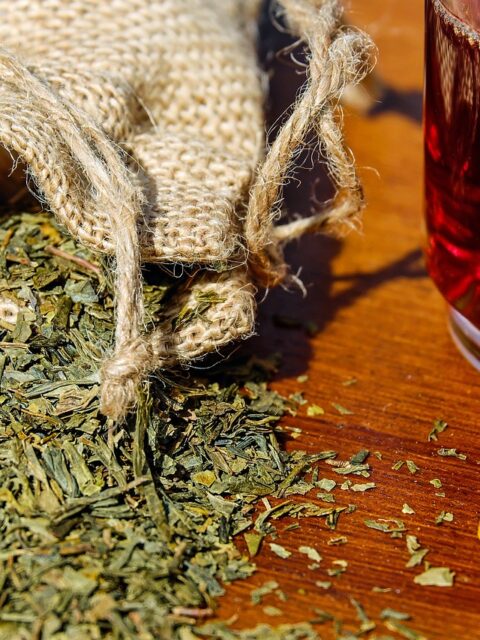
Over time, I stopped trying to fight that feeling quite so aggressively. Instead, I began paying more attention to the transition itself. Making tea became part of that. Not because I expect herbs to solve brain fog. They don’t. If someone struggles with persistent problems concentrating, it is always worth speaking with a healthcare professional to understand what might be causing it. But I have found that the simple act of preparing tea changes the pace of the afternoon. While the water is heating and the herbs are infusing, there is nothing to answer, nothing to correct and nothing demanding my attention for a few minutes.
Perhaps that small pause is just as valuable as the tea itself.
Peppermint has become my favourite companion during the working day because I enjoy its fresh taste. On other days I choose tulsi, especially when work feels particularly demanding. Everyone develops their own preferences, and I think that is how herbs have always been part of everyday life—not as miracle cures but as small daily rituals that quietly accompany us through different seasons of life.
Looking back, I don’t think I needed another productivity technique. I needed permission to slow down for ten minutes without feeling guilty. Maybe the afternoon slump isn’t always something that needs fixing. Sometimes it is simply the body reminding us that we are not machines, even if modern work occasionally expects us to behave like one.
This section contains affiliate links. As an Amazon Associate, Herbs Natura earns from qualifying purchases, at no additional cost to you.
1. Tea Infuser Bottle (Double-Wall Stainless Steel)
Suitable for: Office workers, remote workers and anyone who enjoys loose-leaf herbal tea during the day but doesn’t have easy access to a kitchen.
Why I like it: A good insulated tea-infuser bottle lets you prepare peppermint, lemon balm or tulsi once and enjoy it throughout the afternoon without leaving your desk every hour. It also encourages drinking more water, which many office workers forget during busy days.
Look for:
- double-wall stainless steel
- removable fine-mesh infuser
- leak-proof lid
- dishwasher-safe parts if possible
Recent buying guides consistently recommend stainless-steel vacuum-insulated bottles with removable fine-mesh infusers because they retain heat well and are easy to clean.
Possible limitation: If you mostly drink tea at home and have a kettle nearby, you may prefer a traditional teapot or mug with an infuser instead.
👉 View current price on Amazon
2. COSORI Electric Kettle with Temperature Control
Suitable for: People who drink herbal or loose-leaf tea every day and want a reliable kettle that can also be used for coffee.
Why I like it: Boiling water seems like a small task until you do it several times a day. A kettle with temperature presets makes preparing different teas simpler, heats water quickly and often includes a keep-warm function, so you don’t need to reboil the water if you’re interrupted.
Models with stainless-steel interiors, automatic shut-off and temperature control are consistently recommended by reviewers for everyday tea preparation.
Possible limitation: It costs more than a basic kettle. If you only make tea occasionally, a simpler model may be perfectly adequate.
👉 View current price on Amazon
3. OXO Brew Tea Infuser Basket
Suitable for: Anyone who wants to start drinking loose-leaf herbal tea without buying a teapot.
Why I like it: Sometimes the smallest purchase is the one that changes a habit. A good basket infuser fits directly into an ordinary mug, gives herbs enough space to expand while brewing and is easy to clean afterwards.
Food writers and tea specialists continue to recommend basket-style infusers because they allow loose leaves to expand more freely than small tea balls, improving the brewing experience.
Possible limitation: It works best with larger mugs. If you often travel with tea, an insulated infuser bottle may be the more practical choice.
👉 View current price on Amazon
About the author: Dali writes Herbs Natura from personal experience of modern working life, nature, herbal traditions and the habits that help us reconnect with everyday life. Herbs Natura provides editorial information, not medical diagnosis or treatment.